News & Events
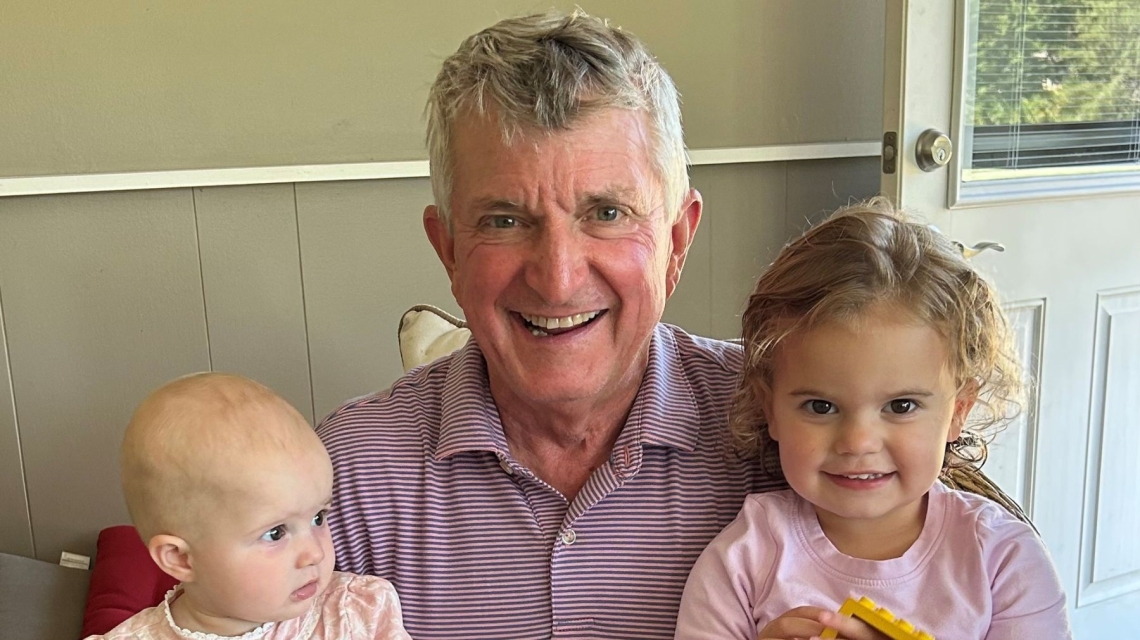
“The most important thing is not graduating and going to college,” he says. “The most important thing is to live that purposeful life where you can be happy and productive.” - Bill Crawford ’76
Growing up in Louisville, Kentucky, Bill Crawford ’76 liked math and the outdoors but didn’t yet know how far either of those things would take him. During a visit to see a friend at Washington and Lee University his junior year of high school, Crawford realized he had found a place where both of those interests could be pursued.
“I looked around Lexington and the campus, this small school,” he recalls, “and it just blew me away.”
The physical beauty of Rockbridge County spoke to him in a way he still finds difficult to articulate. Although Crawford would go on to accumulate 42 hours of math and computer science at W&L, the lesson that has stayed with him longest had nothing to do with course credits. It was delivered, as it was for so many W&L students, at Crawford’s freshman orientation at Natural Bridge.
“Follow the Honor System,” he was told. “Be a gentleman.” Fifty years later, Crawford says he can trace nearly everything that followed back to that moment.
In the spring of 1976, with weeks left before graduating with a degree in economics, Crawford learned about the Chicago Board Options Exchange (CBOE), a new marketplace where someone with strong mathematical instincts like his might be able to earn a living trading financial derivatives. Crawford recalls that at the time there was little published about the field. He found one magazine article in the McCormick library, then located in what is now Huntley Hall, and tracked down a professor who might know something about it.
“It sounded impossible that a career like this would exist,” he says, “where I could use math and my imagination.”
The CBOE was only three years old, still largely illiquid and operating in a world without personal computers. He arrived in Chicago and started as a “runner,” earning about $100 a week while learning the floor. He later enrolled in the University of Chicago’s MBA program and took a class from Myron Scholes, who would later win the Nobel Prize for the Black-Scholes options pricing model. Crawford and a small group of fellow young traders formed a study group, meeting after the market closed to order pizza and teach each other what they were learning on the job. He spent roughly 15 years as a pit trader on the exchange floor — a reactive, physical and intensely immediate kind of work, Crawford says, followed by another decade trading from a desk, which he considers an entirely different profession.
“On the floor, you’re reacting to order flow,” he explains. “At a desk, the phone is never going to ring. You have to figure out what you want to do.”
The CBOE eventually asked Crawford to lead the Market Performance Committee, a new regulatory body overseeing the exchange. He was given wide latitude to choose his committee members, set market-making standards and, when necessary, suspend or terminate floor members.
“We had a lot of power,” he says. “And our exchange never had any scandals. We managed to take care of things internally by following principles and doing the right thing. I have to think it’s because of what I was told at Natural Bridge.”
Crawford says that the idea of teaching was never far from his mind. In ninth grade, he had been hired to tutor a child with dyslexia, and he loved the challenge of finding the right entry point for a different kind of mind. At W&L, he naturally helped other students through calculus and statistics.
“Different students needed different things to understand the same concepts,” he says. “I always liked that.”
Ten years after leaving Chicago, the electricity trading business which he was involved with was sold and Crawford found himself with time for reflection about what he wanted his next career step to be. He remembered his underlying interest in helping others learn. He walked into the Jefferson County Board of Education and asked what it would take to become a teacher.
After obtaining his teaching certificate in 2002, Crawford taught his first class at Iroquois High School in Louisville, an inner-city school with 450 freshmen that graduated around 125 seniors. He says it took him the entire first semester to realize that a full third of his class was illiterate. The students could grasp mathematical concepts in classroom discussion, but they couldn’t read a written test.
“I had some students who were pretty bright in class,” he says, “and then they would take a test and get a 10 out of 100.”
Two-thirds of his students had already failed freshman algebra and many had failed math every year since sixth grade before being passed along to the next grade. Several didn’t know their multiplication tables. Crawford says those students motivated him to keep going. He started the school’s first math team, and the senior class asked him to be their sponsor. After Iroquois, Crawford moved to Walden, a small independent school, where he taught five different math courses from basic algebra to Calculus 2 and successfully pushed the board to require four years of math for all students. His reasoning was that students were arriving at college having gone more than a year without math and failing immediately. Requiring four years, with courses structured to genuinely prepare the weakest students, could change those outcomes. One day during class, his phone rang. It was his son, calling from his own high school to report that his math teacher was leaving.
“I want you to apply,” his son said, assuring Crawford that he had already cleared it with his friends.
Crawford then spent seven years at Kentucky Country Day School, teaching everything from personal finance to AP Statistics, BC Calculus and a self-directed lunchtime AP Economics course for motivated students who had no other available class period.
Crawford retired from teaching about a decade ago but never entirely left education behind. Years prior to Crawford’s retirement, an educator friend of his had started a new endeavor in Louisville’s West End. The founder had gone to boarding school and believed the model — immersive, relationship-based and built on accountability — could work for children that the system had largely abandoned. He and his wife rented a condemned building in the inner city to create a residential program for at-risk boys. Students lived onsite Sunday through Friday, then went home on weekends. Crawford was asked to join the board of the West End School to help shape its future.
The school now serves pre-K through eighth grade, with roughly 15 students per class. In August, it opened a girls’ school, starting with pre-K through second grade, with plans of adding a grade each year. Every student attends on full scholarship, and graduates are placed into the best possible high school situations to match their abilities and needs. Crawford points out that, not unlike W&L, the school holds its students to high standards, an approach that he says helps young people become good citizens.
“The most important thing is not graduating and going to college,” he says. “The most important thing is to live that purposeful life where you can be happy and productive, whatever that means.”
His passion for education has expanded into working with the Commonwealth of Kentucky on advocacy for its teachers. Two years ago, the governor of Kentucky appointed Crawford to the Kentucky Teachers Retirement System Board of Trustees, placing him in charge of overseeing pensions for the state’s public school teachers. The fund has been perilously underfunded for years. Through a combination of increased government contributions, union cooperation and disciplined governance, Crawford says, the fund is on its way to full funding.
“Teachers who have given their careers need to be made whole on their pension promises,” he says. “In Kentucky, it’s going to happen. Not that long ago, that was in danger.”
Washington and Lee also holds a special place in Crawford’s commitment to education. In the 1990s, he and a few Louisville-area friends established the Louisville Scholarship at W&L, a fund to ensure that students from his hometown who wanted to study in Lexington would have the means to do so.
“School is so expensive,” he says. “When I went to W&L, it was marginally more expensive than the University of Kentucky. That’s not the case anymore.”
The scholarship has grown over the years. As his 50th reunion approaches this spring, Crawford has made both a reunion gift and a planned gift to see that it continues.
“W&L was wonderful to me,” he says. “It just seems like the natural thing to help out the next generation.”
Crawford says he doesn’t trace his love for teaching or his philanthropic energy back to any grand plan. He traces it back to the lessons of honor and integrity that were reinforced for him throughout his time at W&L
“If you try to put one foot in front of the other every day and do the right thing,” he says, “it ought to work out.”